
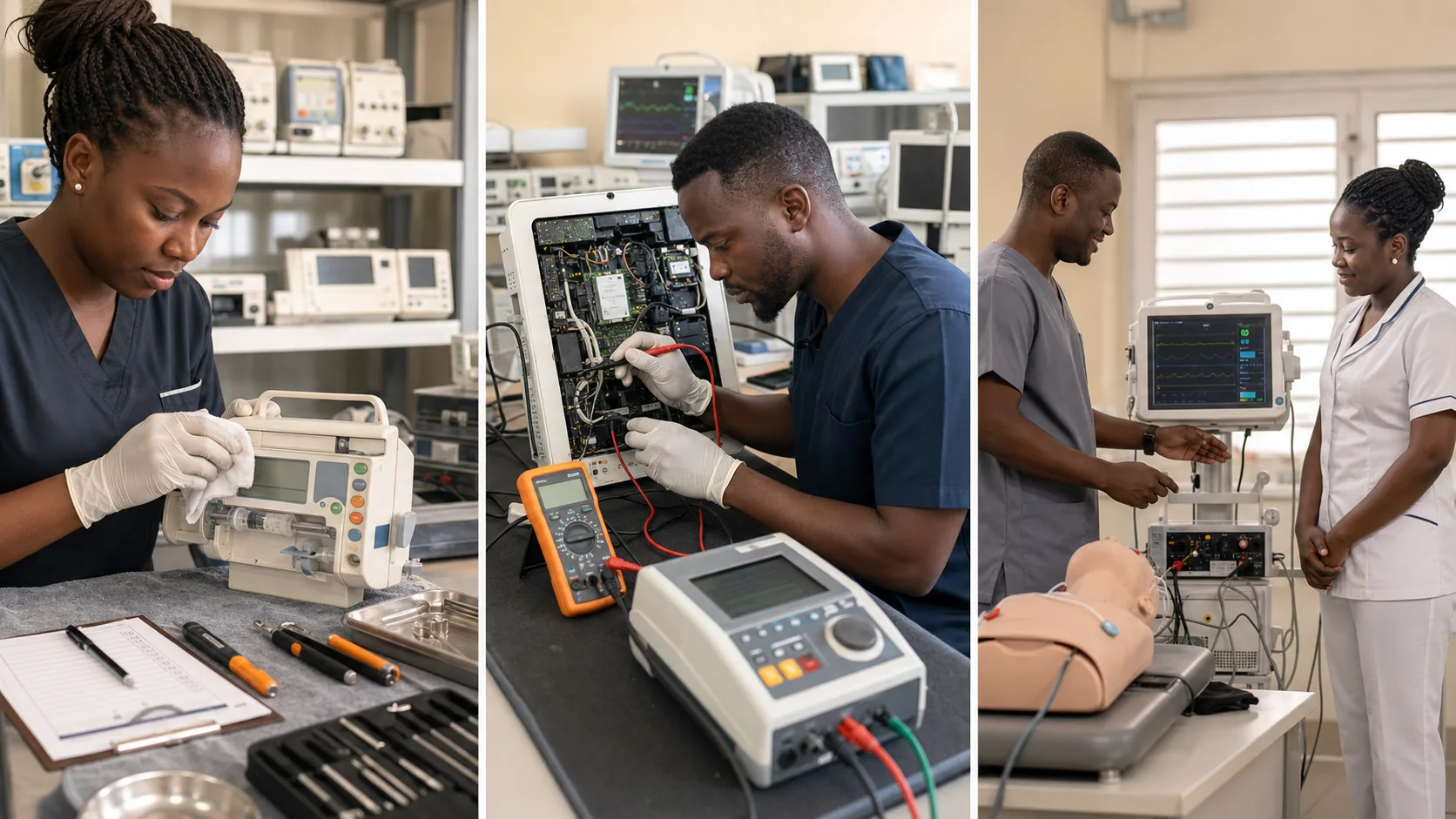
HEALTHCARE TECHNOLOGY MANAGEMENT
Building a biomedical programme that actually works
An operational guide to organising the equipment fleet, priorities, teams, maintenance, data and investment decisions.
A biomedical programme is more than a maintenance schedule.
It is a management system that links clinical needs, inventory, acquisition, acceptance, training, maintenance, safety, data and decommissioning. It must remain proportionate to the available resources and focus effort where a failure would most affect care.
Managing technology from need to decommissioning
The programme must cover the entire lifecycle. A poor acquisition creates years of maintenance difficulties; an incomplete acceptance lets in equipment without documentation, training or parts; unplanned decommissioning clutters departments and muddies the inventory.
Clinical activity, site capacity and expected outcomes.
Specifications, total cost, support and consumables.
Inspection, testing, documents and initial training.
Use, cleaning, checks and incidents.
Preventive, corrective, parts and traceability.
Decision, data, safety and appropriate disposal.
Defining who decides, who executes and who validates
Management sets priorities and resources. The biomedical team organises data, checks and interventions. Users report anomalies and follow instructions. Procurement, logistics, IT, hygiene, radiation protection and clinical leads are involved depending on the technology.
Arbitrates priorities, investments, risks and replacement decisions.
Maintains the programme, procedures, indicators and improvement plan.
Link clinical use, incidents, availability and training needs.
Work within a documented contractual scope with lead times, parts and expected results.
Identifying equipment before planning its maintenance
The inventory must be kept continuously up to date. Start with assets in service and the equipment that supports essential clinical functions. A unique identifier on the equipment must match a single record in the register or the CMMS.
Internal ID, standardised designation, manufacturer, model and serial number.
Facility, building, department, room and user in charge.
In service, out of order, in reserve, quarantined, on loan or decommissioned.
Clinical role, risk in case of failure, frequency of use and backup solution.
Last intervention, next due date, contract, warranty and qualified service provider.
Manuals, procedures, certificates, parts, accessories and decision history.
Focusing resources on risk and clinical mission
WHO describes several complementary approaches: prioritisation based on risk, on the facility’s mission and on the resources actually available. The chosen method must be written down, understood and applied consistently.
Consequence of failure
SafetyEquipment whose failure could injure a patient or an operator receives heightened attention.
Importance for care
Clinical continuityTechnologies essential to the facility’s priority activities must remain available.
Intervention capacity
FeasibilitySkills, tools, parts, documentation, contracts and budget determine what can be properly maintained.
Use and backup solution
Actual exposureVolume, environment, mobility, age, failure rate and the availability of replacement equipment change the priority.
You can rate each criterion from 1 to 5 and document the reasoning. The final decision must remain validated by clinical, technical and safety leads.
Choosing the right mix of inspection, preventive and corrective maintenance
Checks that the equipment poses no unacceptable hazard to patients, users or the site.
Confirms that functions and results remain suited to the intended clinical use.
Planned servicing and replacement to limit wear and reduce certain failures.
Diagnosis, repair and documented check before return to service.
Frequency must combine manufacturer recommendations, regulations, risk, local experience and failure history. Avoid applying the same frequency across the whole fleet.
Moving a request along without losing information
Equipment, symptom, department, impact and urgency.
Withdrawal, tagging or interim measure depending on risk.
Cause, scope, parts and skills required.
Action taken, time, parts and service provider.
Tests, status, user informed and work order closed.
Matching tasks to authorisation levels
Users can perform the scheduled pre-use checks and daily care. Technicians work within their area of competence and with the necessary tools. Complex, radiological, connected or high-risk systems sometimes require the manufacturer, a specialised provider, a medical physicist or a competent authority.
Preparing for what usually blocks a repair
Identify the parts whose absence takes priority equipment out of service: batteries, sensors, cables, seals, filters, preventive kits and long-lead-time components. Define a stock level, a storage condition, a validated equivalent and a person responsible for replenishment.
For external contracts, make visible the scope, exclusions, response times, parts availability, return-to-service testing, documentation and end-of-support conditions.
Digitising a clear process, not its disorder
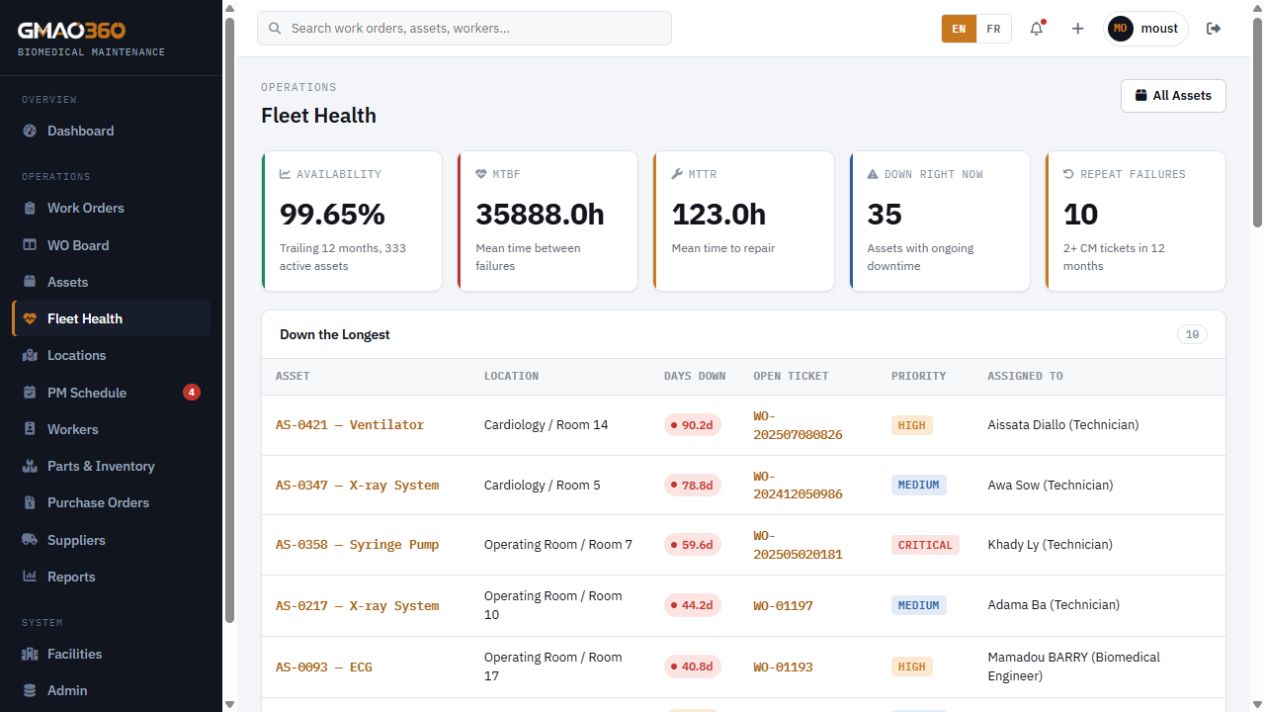
A CMMS must, at a minimum, link inventory, histories, work orders, preventive procedures, parts, costs and indicators. Start with few mandatory fields, check their quality and expand afterwards. A well-governed spreadsheet can be a first step; moving to a CMMS becomes relevant as volume, sites and responsibilities grow.
Measure to decide, not to fill a dashboard
Share of equipment physically located, identified and linked to an up-to-date status.
Scheduled interventions completed within the agreed period, by priority level.
Time during which priority equipment is usable for its intended clinical activity.
Average time between a breakdown being reported and the equipment returning to service, interpreted by equipment family.
Similar failures recurring after repair and requiring a root-cause analysis.
Labour, parts, contracts, travel and downtime, related to the service delivered.
Analyse indicators by facility, department, equipment family and priority level. An overall average can hide the unavailability of an essential device.
Establish a sustainable routine before seeking perfection
See the fleet
Appoint a manager, list the priority equipment, assign identifiers and secure immediate risks.
Organise the work
Define the request workflow, statuses, priorities, essential procedures and a realistic schedule.
Manage and improve
Measure the first results, correct the data, address repeat failures and prepare the next budget.
Fund the lifecycle, not just the purchase
The budget must cover labour, contracts, parts, consumables, test tools, calibration, software, training, cybersecurity, travel and replacement. For a new purchase, ask for the total cost over the expected period of use and check the skills and infrastructure available.
Specifications, parts availability, documentation, training, warranty, technical data and acceptance tests must be negotiated during acquisition.
Build the programme on recognised benchmarks
WHO guides cover inventory, the maintenance programme and computerised systems. Adapt them to national requirements, the clinical mission and the facility’s resources.