
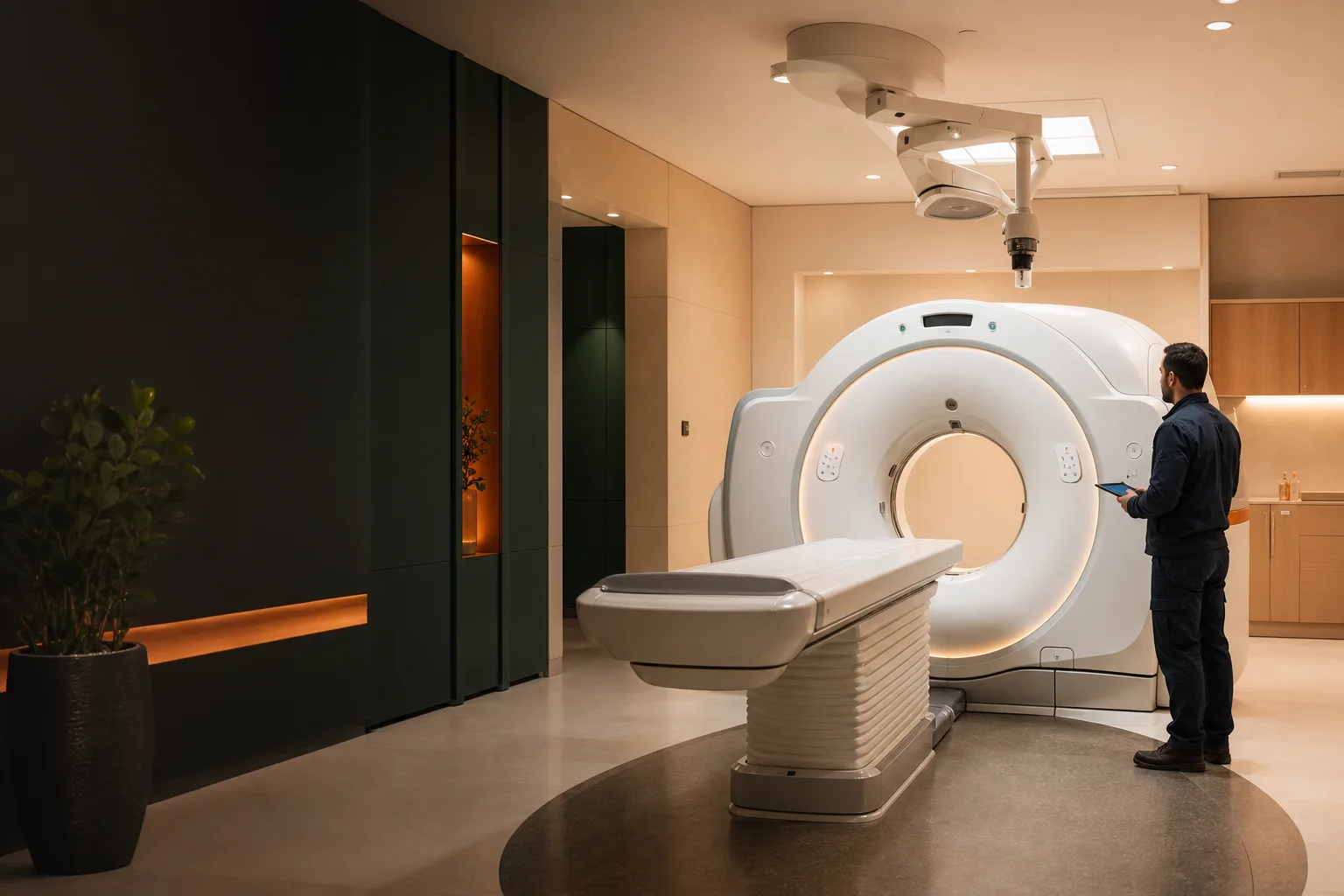
BUYER’S GUIDE / 2026
Buying a CT scanner: price, configuration and total cost
A practical framework connecting clinical needs, technology, site readiness and whole-life cost.
Slice count does not make the decision alone.
Two scanners advertised as “64-slice” can serve very different uses, constraints and budgets. A sound comparison starts with the clinical programme, then examines system condition, software, tube, site readiness and available support.
Start with examinations and patient flow
List planned examinations, daily volume, emergency workload, patient profiles and the expected level of specialisation. General imaging, cardiac work, oncology, trauma and perfusion do not demand the same capabilities.
This step separates essential functions from attractive but underused options. It also helps size reconstruction speed, detector coverage, software, injector and workstation requirements.
What budget bands apply in 2026?
Depending on generation, configuration and refurbishment level, a CT scanner may range approximately from USD 90,000 to 900,000 on the US market. These figures are neither Bio-MedX prices nor a quotation; they are discussion benchmarks only.
Entry level
USD 90,000–130,000Often 16-slice or older 64-slice platforms, suited to routine non-cardiac examinations and controlled volumes.
Mid-range
USD 130,000–190,000Better-equipped 64-slice configurations, with more software options and broader clinical capabilities.
Premium
USD 200,000–300,00064- to 320-slice platforms for advanced uses, depending on generation, detector and included software.
Ultra-premium
USD 300,000–900,000Recent very-high-performance systems, often configured for specialised or high-volume programmes.
Configuration matters as much as generation
Slice count, detector width, rotation speed, generator power and table capacity must be matched to planned examinations.
Calendar age is not enough. Request usage history, replacements, errors, available hours or rotations and warranty conditions.
Cardiac, dose reduction, iterative reconstruction, perfusion, virtual colonoscopy and oncology features may depend on separate licences that may or may not be transferable.
Air cooling or chilled water, thermal load, power supply, earthing and electrical continuity materially affect site preparation and downtime risk.
Compare refurbishment scope, not just the label
“Refurbished” can describe very different conditions: as-is sale, cosmetic refurbishment or a complete process including testing, replaced parts, calibration and warranty. As an indication, a refurbished platform may cost roughly 30% to 70% less than a new system, depending on model, condition and scope.
Serial number, year, software configuration, maintenance history, tube condition and history, test report, accessory list, warranty terms, installation responsibilities and parts availability.
Budget for everything around the scanner
WHO recommends a total-cost-of-ownership approach covering acquisition, installation, training, maintenance, consumables, energy, infrastructure and human resources. For a CT scanner, the advertised price is therefore only part of the project.
Validate the building before committing to purchase
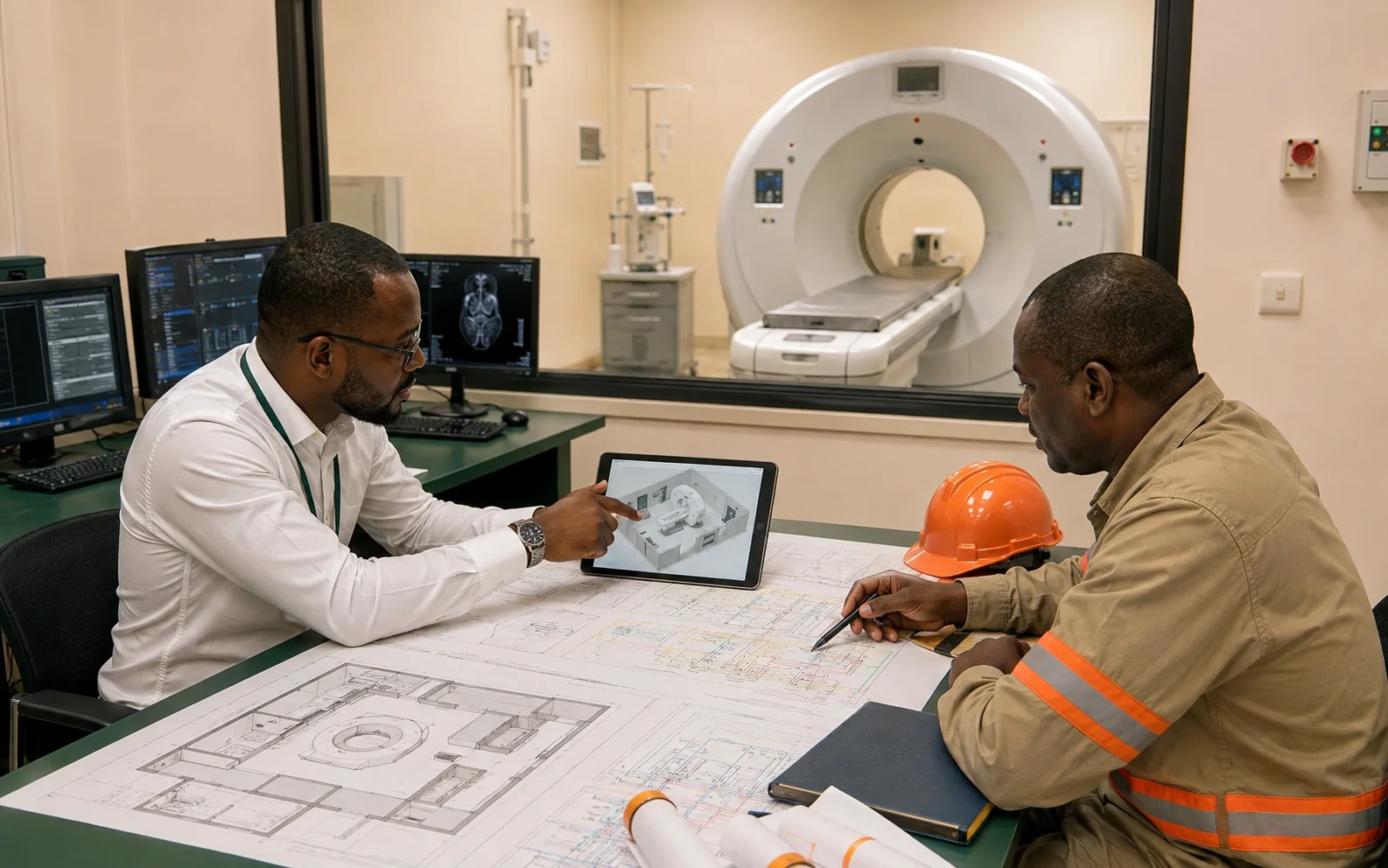
The manufacturer or integrator should provide model-specific drawings and requirements. Room dimensions, floor loading, access route, control room, available power, earthing, air conditioning, cooling, radiation protection and IT connections must then be confirmed.
Where power quality, heat, dust or parts availability are constraints, these factors should shape platform selection—not merely the building work that follows.
Six questions before comparing offers
- Which examinations will be performed from opening, and which are planned in the medium term?
- What daily volume, operating hours and level of emergency workload must it absorb?
- Does the price include the tube, accessories, licences, installation and training?
- What is the history of the system, the tube and the main interventions?
- Who will provide maintenance, with what response times and what parts availability?
- Are the electrical, thermal, network and radiation-protection requirements documented?
See the technology in operation
This video complements the guide with a visual introduction to CT technology. It plays directly here without leaving the Bio-MedX site.
Benchmarks to confirm for each project
The total-cost approach reflects World Health Organization health technology management guidance. Market ranges remain indicative, and final requirements must always be validated with the manufacturer, relevant authorities and site specialists.